

Chapter 1
Pre-History to 1500 AD
Verse as Memory Tech
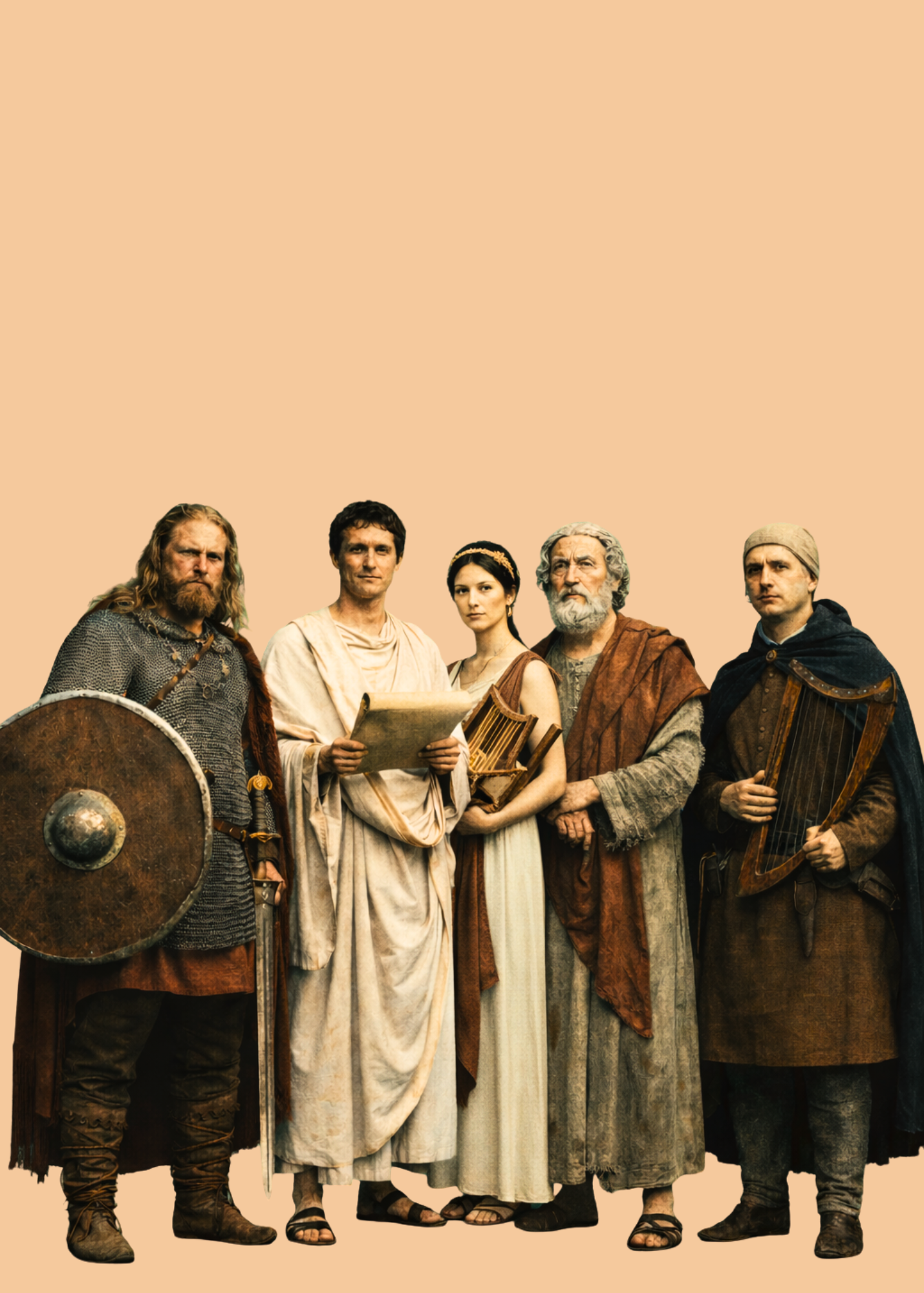
Before print, poetry was used to spread information and make it stick, instilling laws, moral frameworks, and lineages, etc.
Verse was collective, anonymously authored, and anchored in collective interests
Here we have formal epics, fringe rhymes, and cosmic translations
Scroll down for more
CORE FUNCTIONS
Memory
Metre, repetition and rhythm were used to weave important information into the human mind so it could be disseminated and sustained by populaces
(Poetic Edda, Laws, Commandments)
Civilizational Definition & Externalization of Inner Dramas
As tribes gathered into large clusters of organized civilization, Poetry became a took for setting the tone, providing moral frameworks, value systems, enemy and alliance definitions, and heroic ideals. As well as the externalization of inner conflict into mythic narrative. ( Beowulf, Homeric Epics, Aeneid, Gilgamesh )
Social Bonding & Strategy, and Emotional Amplification
Catchy little verses were used by commoners not to tell grand stories or grapple with existential dilemmas but to add colour to tasks, strategy to courtship, voice to sorrow, and platform to political critique. Communal resonance was struck by harmonized recitation, creating a sense of shared experience and collaboration
(Shijing, Ballads, limericks, Hymnals, laments)
Cosmic Bridging
Invocation, order, and alignment; creating a bridge between human beings and reality’s structure. Sometimes to honour, sometimes to alter.
(Chants, invocations, hymns, laments, Rumi, Dante, Rig-Veda)
Individual Mystical Dissolution
Poetry to express the individual ecstatic experience in relation to love and loss of self through music.
(Rumi)
A sword may end a life, a verse well-formed may sway a generation
POETIC PRINCIPLES
What helps poems attain their impact and staying power
Metre
Rhythmic predictability stabilizes retention for easy memorization
Repetition
A word or phrase repeated instils and reinforces its meaning and feeling in the psyche
Formulaic language
Formula is used to create a sense of authority and sustainability
Epic
The epic uses grandiosity to create a sense of importance and inevitability
Musicality
The musical use of words sways feeling and can be used to induce various emotional states, reinforcing impact bodily
Story
The use of identifiable characters and narrative structure to instil empathy and a sense of shared experience
LET’S ZOOM IN
Prehistoric to 15th Century AD
ordered for structural flow not chronology
ORPHEUS
The Physics of Verse
(Greek Myth, 6th century BC)
The original archetypical poet of Greek Mythology
Son of a Muse whose music alters realities
“Birds, beasts, and long-lived trees gathered about him, drawn by the sweetness of his song.”
Orpheus is one of humanity’s original archetypal poets. He is depicted as being so gifted that his verses bend reality to his will, both in the material realm and in the realm of spirt and gods. This gives us a sense of how powerfully poetry was regarded from its inception.
In his most famous adventure, Orpheus uses his music to seduce the Gods of the Underworld into granting him access so that he may retrieve his deceased beloved. He succeeds to a degree, gaining entrance, and even guiding his beloved out to a point… but she vanishes back when he missteps, breaking the spell of his song with a doubtful glance back to make sure she is following him. He has broken the spell of feeling with thought and lost his love.
For better or for worse, Orpheus teaches us that music casts a spell that thought destroys
CONTEMPORARY TIE-IN
See the echo of music as a lure out of the underworld in the show Stranger Things, in which a Kate Bush song creates a portal for escape from the UpsideDown World, reviving the spirit and restoring it to the realm of the living: animating force
If I only could, I’d make a deal with God, and get him to swap our places
Music as bridge between the dead and living; it is a core component of what it means to be alive
BEOWULF
The Fight of Man and Nature
(Anglo-Saxon, unknown author, 700 AD)
The thin membrane of civilization and the contrast between light and dark
Plot: A monster, Grendel, attacks a King’s great hall whenever he hears merriment. Our hero, Beowulf, comes from away to slay the monster and liberate the kingdom. He succeeds but is eventually taken out by a larger more vicious monster years later.
Let’s look at the poem as a distillation of the underlying current of the collective unconscious grappling with light and dark, civilization and the wilderness.
“It is always better
to avenge dear ones than to indulge in mourning.
For every one of us, living in this world
means waiting for our end. Let whoever can
win glory before death. When a warrior is gone,
that will be his best and only bulwark.”
- Seamus Heaney translation
The quote crystallizes the through-line here: nature wins but man fights anyways.
See echos of this in the fairytale Sleeping Beauty in which the the dark sorceress Maleficent is not invited into the hall of light and so storms in with a curse for the princess
To cast out the unwanted is to make a monster of it. And the monster in turn attacks. With Beowulf poetry captures the first true struggle of man and offers the only solution it can at the time: fight.
RIG-VEDA
Cosmic Alignment
(Multiple Authors, India, 1500 BC)
While Beowulf uses verse to distill man’s psyche and Orpheus to seduce and sway fate, Rig-Veda uses it to anchor the fabric of reality itself.
Authors as conduits rather than creators, harnessing the sounds of creation into verse.
Here sound precedes meaning and is in and of itself a co-creative force. Hymns are structural offerings, metre is sacred geometry, and chants are structurally encoded order, aligning the human with cosmic order through sonic resonance.
The Rig-Veda does not describe the universe but rather stabilizes it
“The Moon was born from his mind;
from his eye the Sun was born;
From his mouth Indra and Agni;
from his breath the Wind.”
Here form and metre becomes shared anatomy between the cosmic and material
Poetry is part of the the structural scaffolding of the universe
SHIJING
Ritual and Communal Resonance
(Multiple authors, Northern China, 10th Century BC)
From epic and cosmic incantation to the subtle engineering of everyday life
These are works not for kings and mystics but for the everyday person, offering verse for the function of courtship, labour, emotional processing, political critique, and ancestral hymns.
“Pluck the reeds, pluck the reeds,
the reeds are lush and green.
The one I long for
is somewhere by the water.”
This verse works on a number of levels, providing instruction, sonically inducing pleasure to accompany the task, and nodding to life-amplifying social dynamics and courtship.
Labour and love captured in rhyme
RUMI
And the Dissolving Self
(13th Century Persia)
Functional, emotional, interpersonal
TRANSITIONAL FIGURE
With Rumi we now move from collective experiences to individual with exotic expressions of the poet’s own internal state primarily focused on longing and ecstasy, with language as incantatory of the state it expresses
“I died as mineral and became a plant,
I died as plant and rose to animal…
Why should I fear? When was I less by dying?”
Rumi’s work is deeply mystical, expressing the cosmic not by myth or narrative but by direct personal experience and emotional reckoning
While other works of the time crystallized cosmos and civilization into form, Rumi took the form of the individual and dissolved it into love, leading us into a new era
-
•Homer’s Illiad and Odyssey (Greek)
•The Epic of Gilgamesh (Mesopotamia)
•The Poetic Edda (Iceland)
•Mahabharata (India)
•Aeneid (Roman)
•Epic of Sundial (West Africa)
•Dante’s Inferno (Italy)
•Sappho (Isle of Lesbos)
•Upanishads (India)