

Chapter 2
1950-1980
I am poet, hear me roar!
“Poetry is not a luxury.”— Audre Lorde
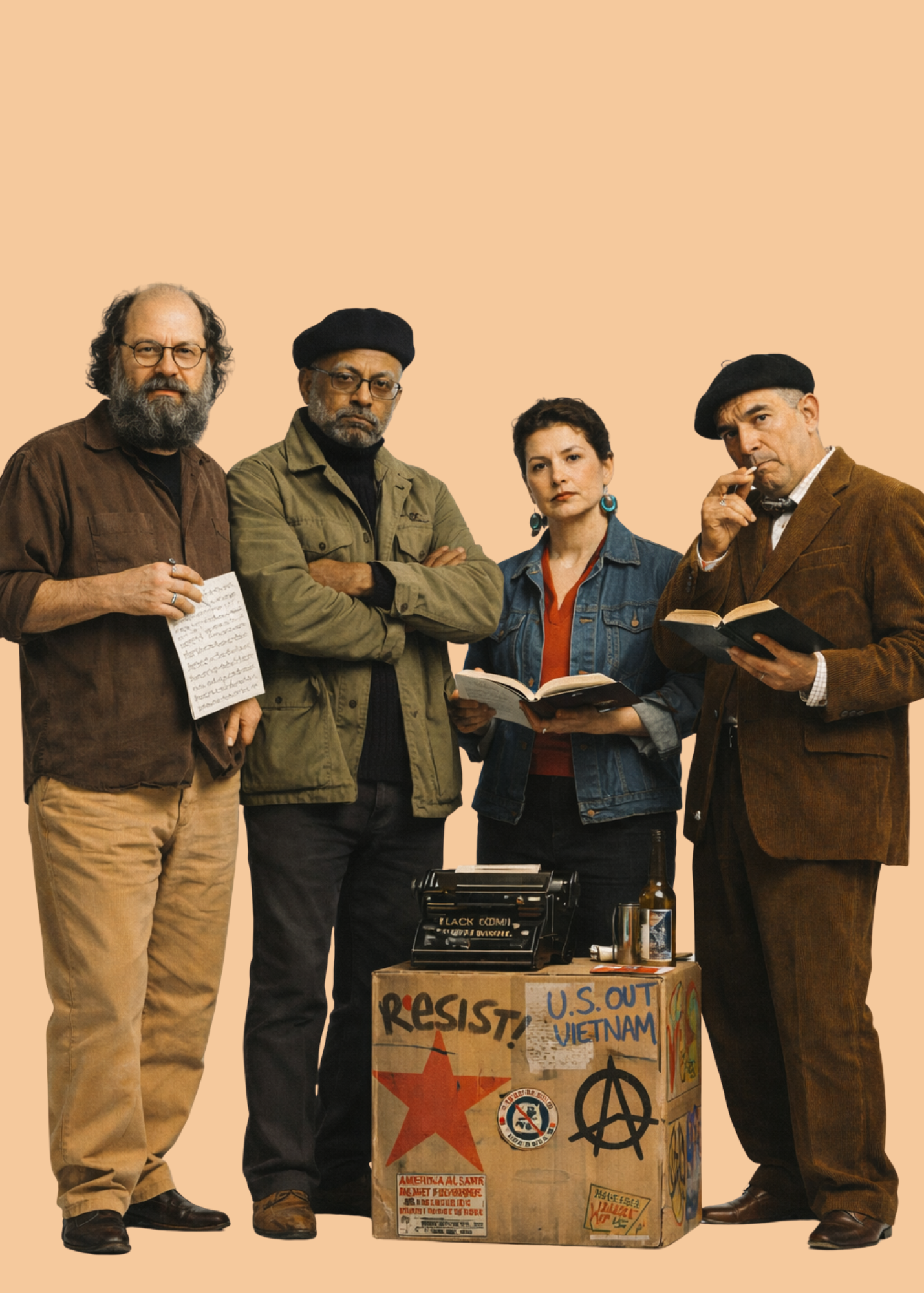
This subsection of poets marks a shift from contemplative, expressive, and experimental, to fully armed, loaded, and functional. These poets saw what verse could do and used it to make ripples in reality, no longer ruminating in the ruins but making tools of what they found there.
Figures like Allen Ginsberg explode poetic form with prophetic rant and ecstatic confession, tearing the veil off the difficult truths of the average citizen while The Black Arts Movement transforms poetry into a tool of cultural and political liberation.
Confessional poets push the personal voice to raw new levels of vulnerability and poetry becomes not only reflection, but revelation, protest, and performance.
Scroll down for more
CORE FUNCTIONS
Social Intervention
Poetry moves out of the academy and into public life. Poets address political injustice and social upheaval directly. The poem becomes a tool for critique, resistance, and change
Radical Personal Exposure
Private experience becomes legitimate poetic material. Mental illness, sexuality, family conflict, and trauma move from the margins into the centre of poetic expression.
Cultural Identity & Liberation
Poetry becomes a vehicle for reclaiming suppressed histories and asserting cultural identity. Movements like the Black Arts Movement use poetry to amplify voices historically excluded from literary institutions.
Public Voice & Performance
Poetry returns to oral performance traditions, spoken aloud in cafés, protests, and informal gatherings.
POETIC ELEMENTS
Naturalistic Lines
Poets like Ginsberg abandon tight stanza forms in favour of extended lines shaped by speech and breath.
Direct Address
The poem speaks plainly to the reader or audience, often confronting social or political realities with clear and accessible language.
Spoken Cadence
Poetry reflects everyday speech patterns rather than literary ornamentation.
Confessional Voice
The poet reveals personal psychological experiences openly, collapsing the distance between author and read
ZOOMING IN
ALLEN GINSBERG
Fevered Eruption
(Late 20th Century America )
With the Beat Generation, poetry explodes outward again. Ginsberg rejects the restraint and intellectual distance of modernism, replacing it with long, naturalistic lines, ecstatic confession, and political outrage.
His landmark poem Howl transforms poetry into something closer to a public chant or sermon. The voice is raw, emotional, and prophetic, addressing the alienation of postwar America.
Rather than carefully arranging fragments like Eliot or Pound, Ginsberg unleashes them in a torrent of speech.
The poem becomes performance, protest, and personal revelation all at once.
“I saw the best minds of my generation destroyed by madness, starving hysterical naked…”
AMIRI BARAKA
Poetry as Political Weapon
(Late 20th Century America)
Amiri Baraka pushes poetry into direct political action. A central figure of the Black Arts Movement, Baraka argues that poetry should actively challenge systems of racial and cultural oppression.
For Baraka and the Black Arts Movement, poetry is not merely aesthetic expression. It is cultural resistance.
The poem becomes a tool of liberation, addressing Black identity and power dynamics with direct and confrontational language.
“Poems are bullshit unless they are
teeth or trees or lemons piled
on a step…”
ANNE SEXTON
The Poem as Psychological Exposure
(Late 20h Century America)
Anne Sexton takes a subtle shift here, moving from outward protest to inward confessional, where the private life becomes the central material of the poem.
Building on the psychological intensity of poets like Plath, Sexton writes openly about mental illness, sexuality, motherhood, and personal trauma.
The poem becomes a site of radical honesty, making the struggles of the individual known to the world through raw revelation.
Poetry opens itself now to taboo, tumult, and the airing of dirty laundry in such a way that decreased alienation, letting others know that they are not alone in the more messy and otherwise unmentionable personal struggles.
“I have one out, a possessed witch,
haunting the black air, braver at night…”
Having broken open the structures of authority, voice, and subject, poets now enter a new landscape, one where no single movement or method can dominate.
-
•Adrienne Rich
•Audre Lorde
•Nikki Giovanni
•Sonia Sanchez
•June Jordan
•Roque Dalton
•Ernesto Cardenal
•Mahmoud Darwish