

Chapter 1
1500-1800 AD
Exit the Collective Body and Enter the Individual Mind
Gutenberg creates the printing press around 1400 AD and everything changes
Verse moves from body to page, from collectively-owned to individually manufactured, and from fundamentally functional to speculatively existential. Now that doctrine can be set to text, a memorizable rhyme is no longer the tool of choice for governance; it is freed to be explored at length and put to page by individual authors.
Scroll down for more
CORE FUNCTIONS
Authored Thought & Individual Voice
With the printing press, poetry leaves the communal body and becomes an authored artifact. The poet emerges as a recognizable individual whose voice can circulate widely and persist through time.
Psychological Interior & Moral Inquiry
Poetry becomes a theatre of consciousness. Instead of heroic action, the poem dramatizes thought, doubt, and internal conflict. The mind becomes the new battlefield.
Cosmic Interpretation & Philosophical Reframing
Rather than stabilizing mythic cosmologies, poets reinterpret them. Ancient religious and moral systems are retold through the lens of individual perspective and style.
Formal Mastery & Craft Discipline
With poetry now living on the page rather than in oral performance, formal precision becomes paramount. Structured metre, rhyme schemes, and rhetorical balance demonstrate mastery and authority.
POETIC ELEMENTS
Soliloquy
A character speaks their thoughts aloud, allowing poetry to dramatize internal consciousness rather than external action.
Sonnets & Structured Metre
Tightly controlled forms reflect intellectual clarity and rhetorical skill.
Rhetorical Argument
Poems increasingly function as philosophical or moral reasoning rather than purely narrative myth.
Authorial Signature
Poetry becomes identifiable with a particular mind and style rather than communal tradition.
ZOOMING IN
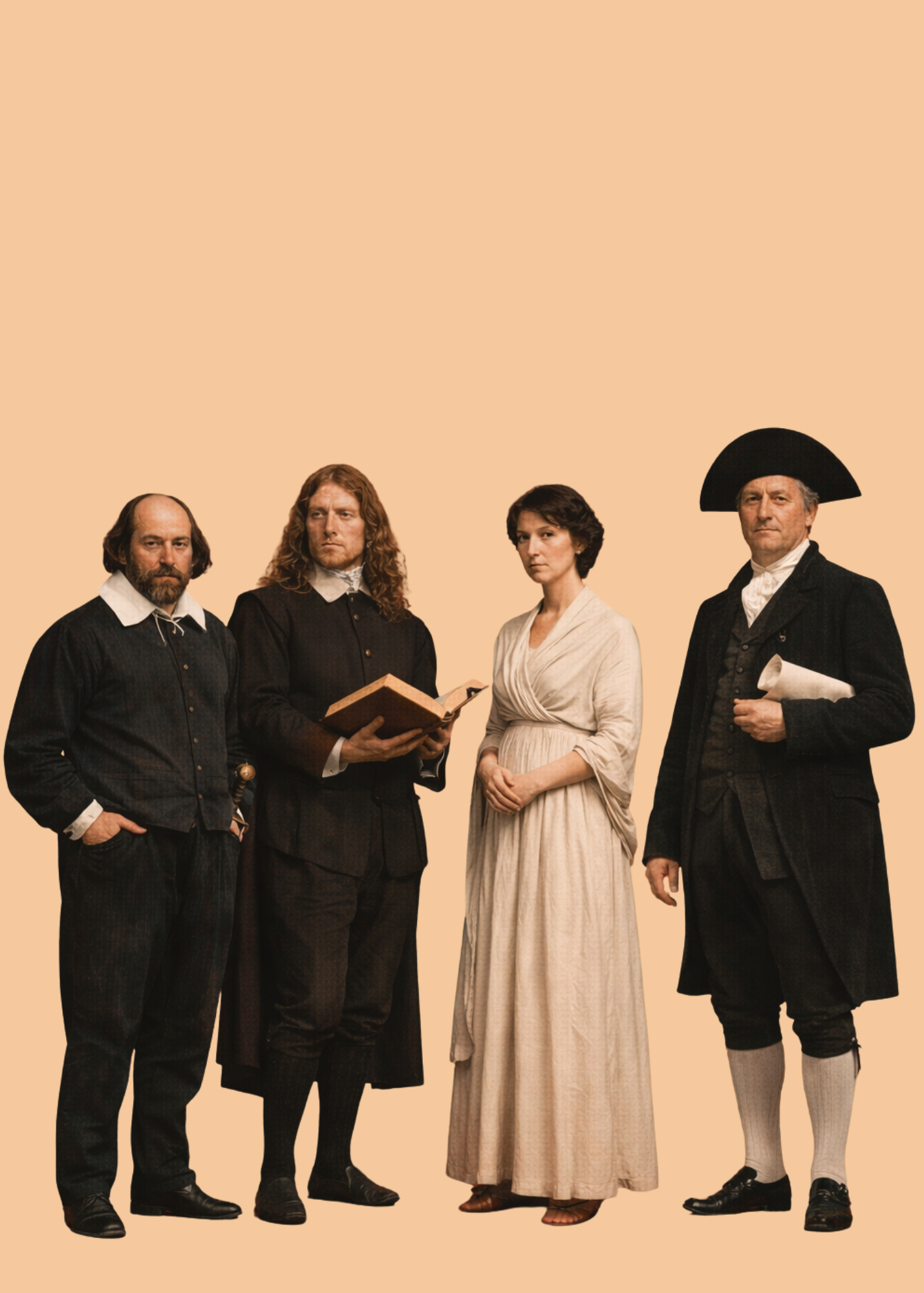
WILLIAM SHAKESPEARE
Psychological Interiority
(1600 AD England)
Language becomes a theatre of consciousness rather than a manual of action: In epics heroes act, in Shakespearian works they think
The soliloquy is a breakthrough form here:
“But man, proud man,
Drest in a little brief authority,
Most ignorant of what he’s most assur’d
His glassy essence, like an angry ape
Plays such fantastic tricks before high heaven
As make the angels weep.”
- Isabela, Measure by Measure
Shakespeare’s verse frequently suspends action so consciousness can speak, not to deliver moral certainties but to call the whole drama of existence into question with a nod to inescapable uncertainty.
Where in Beowulf we see man rush to arms and fight the beast without thought, we now see a character like Hamlet engage so deeply in contemplation that he cannot act at all. Or take Macbeth whose fate seems sealed and actions doomed, leaving poetic contemplation the only place for movement.
“Tomorrow, and tomorrow, and tomorrow,
Creeps in this petty pace from day to day,
To the last syllable of recorded time;
And all our yesterdays have lighted fools
The way to dusty death.”
…
“Life’s but a walking shadow, a poor player
That struts and frets his hour upon the stage
And then is heard no more.”
- Macbeth
Where poetry used to stabilize moral systems, Shakespeare now uses it to destabilize. We do not know. We only think of what we could know. He is not teaching you what to do but how to think. And in this shift clarity and structure begins to dissolve.
For Shakespeare thought interprets action
For Beowulf thought does not arise at all
And for Orpheus thought is the thing that breaks the spell
JOHN MILTON
INTERIORIZED COSMOLOGY
(1600 AD England)
Unlike the works in Rig-Veda, which honour and reinforce the music of the Cosmos, Milton imposes his distinctive verse style to create a universe within the universe, poetry no longer reinforcing but rather replacing the natural movements of cosmic reality with individualized style and interpretation
Milton takes the publicly owned anonymously authored cosmology of the Bible and reinterprets it under individualized authorship in his canonical Paradise Lost. Like Shakespeare, his retelling fractures certainty and creates a drama that calls the reader into the fold, offering temptations and allowing an ambiguity that does not enforce itself but rather lets the reader land on whatever side of Paradise they choose to land (consciously or unconsciously)
Milton’s Satan is not a clear figure of evil. He is a nuanced character of seductive depth, maturing humanity from simplistic dualistic prescription into the awareness that true moral challenges are more complex than can be tackled with a simple “do not enter” sign.
Beowulf’s monster reveals her monstrosity blatantly. Humanity perceived their struggles as simple. It was easy to identify good from evil. Like Shakespeare, Milton introduces nuance and complexity to the questions of good and evil, creating a monster who does not advertise his monstrousness up front but is instead intelligent, seductive, and even compellingly reasonable.
From pre-print to print, humanity moves from easy answers to complex quandaries and Shakespeare and Milton are here to both guide us through increase complexity and exasperate it simultaneously
Again we move from externalized drama to internal. The monster to slay is not standing before us covered in blood, but is whispering in the mind as a seductive thought. We are no longer learning to act but to think.
“The mind is its own place, and in itself
Can make a Heaven of Hell, a Hell of Heaven.”
- Satan, Paradise Lost
TRANSITIONING FORMAL MASTERY
This early print era marked the high point of poetic formal mastery. With figures like Milton, Shakespeare, and Alexander Pope positioning themselves as masters in the early days of authored verse, they created and perfected structure formal constraints, adhering to mathematically precise pentameter and carefully measure metrics which were soon to be reformed, fractured, and experimented with, signifying an even deeper drop from collective coherence into individualized self-expression.
-
Alexander Pope
John Donne
Andrew Marvell
Sor Juana Inés de la Cruz
Matsuo Bashō
Lope de Vega
Pierre de Ronsard